Slowing Performance Across Denver Apartment Market



A ripe construction pipeline across the Denver apartment market has spurred demand over the last few years, but occupancy and rent change fundamentals are feeling the pinch.
The Denver apartment market, home to 360,552 existing units, is situated between the Rocky Mountains to the west and the High Plains to the east. Known as the Mile-High City, Denver serves as a cultural hub sitting nearly 600 miles from the next most populous metropolitan area and is sandwiched between the Boulder and Colorado Springs apartment markets.
As Colorado’s capital city, Denver benefits from a diverse mix of industries including aerospace, life science, IT-software and financial services. Sometimes referred to as the Wall Street of the West, Denver is home to four Fortune 500 companies – Newmont, DaVita, VF and Ovintiv.

Outdoor enthusiasts flock to the Mile-High City for the abundant sunshine. With close proximity to the Rockies, outdoor access to activities like hiking, skiing and mountain biking proliferate. Several major sports teams call Denver home including the Denver Broncos (NFL), Colorado Rockies (MLB), Denver Nuggets (NBA) and the Colorado Avalanche (NHL).
Denver boasts a highly-educated and innovative workforce ranking #3 for tech worker concentration, according to the Denver Metro Chamber of Commerce. The market is home to the University of Colorado Denver, University of Denver, Regis University, Metropolitan State University of Denver and the Community College of Denver, providing a steady pipeline of highly skilled workers.
Top employers, access to education and outdoor recreation opportunities make Denver a city with a desirable quality of life, an attractive choice for young adults in the 20- to 34-year-old cohort, a crucial component of the apartment market. That cohort accounts for approximately 23% of the metro’s population.
Apartment developers rushed to meet a growing population over the last four years. In 2022, more than 32,400 units were in the construction pipeline, according to data from RealPage Market Analytics. In 2024, nearly 18,700 units completed in Denver, expanding inventory 5.7% year-over-year – an all-time high for the market.
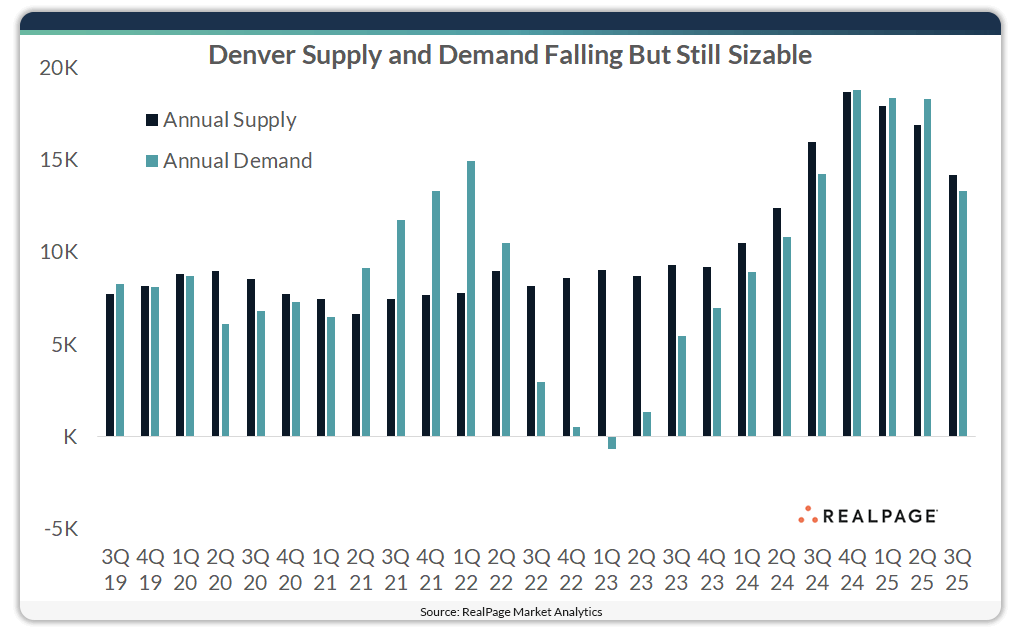
Most recently, inventory growth fell to 4.1%, with only 14,185 units delivering in the year-ending 3rd quarter 2025. Though down from recent highs, that pace still ranked Denver #6 for annual inventory growth among top 50 markets. This was the fourth consecutive quarter that Denver ranked in the top 10, even as the construction pipeline dwindles.
Over the last five years, Northeast Denver snagged the lion’s share of deliveries in the market followed by Downtown/Highlands/Lincoln Park and Five Points/Capitol Hill/Cherry Creek. These three submarkets accounted for about 44% of completions during that time frame. In the year-ending 3rd quarter 2025, seven of Denver’s 19 submarkets received 1,000 or more units. Northeast Denver (2,583 units) again led the market for supply, followed by Tech Center (1,452 units) and Downtown/Highlands/Lincoln Park (1,451 units).
As of November, RealPage is tracking some 13,534 units under construction with about 7,200 of those units expected to complete over the next four quarters. A total which falls below the five-year average for annual completions (roughly 10,675 units). Still, that would increase the inventory base by another 2%.
The construction pipeline continues to cool with Northeast Denver as the only submarket expected to receive more than 1,000 units of projected deliveries over the next four quarters. Just 1,525 units or about 21% of the market total are expected in the Northeast Denver submarket followed by the Downtown/Highlands/Lincoln Park submarket with about 960 units.
For a while demand rose to meet elevated construction levels, chasing supply. Absorption in Denver surged to an all-time high in 2024 with demand for more than 18,800 units. However, over the last 12 months, levels decelerated to demand for only 13,328 units in the year-ending 3rd quarter 2025. While falling short of annual supply, that volume still outpaced the five-year average for annual demand (around 9,650 units). Following supply, 3rd quarter demand was strongest in Northeast Denver, Downtown/Highlands/Lincoln Park and Tech center over the last year.
Even as demand climbed to elevated levels, it has not been able to keep pace with supply, resulting in increased vacancies. As of November 2025, occupancy in Denver landed at 92.8%, backtracking 30 basis points (bps) month-over-month and 150 bps year-over-year. That rate was 190 bps below the U.S. norm, 100 bps below the South region average and the fourth weakest occupancy rate among the nation’s top 50 markets, ahead of only San Antonio, Austin and Jacksonville. It also came in 190 bps below the five-year average occupancy rate.

Looking at product classes in Denver, Class B product led the market with occupancy of 93.2% in November. Class A product was weaker at 92.8%, while the more affordable Class C assets were 92.3% occupied. Only Southeast Denver peaked above 94% occupancy in October, while the majority of the remaining submarkets registered occupancy around 92% to 93%. Occupancy in three submarkets reached 93.8%: Arvada/Golden, Broomfield and Littleton. The market’s worst rate was in Glendale (89.6%).
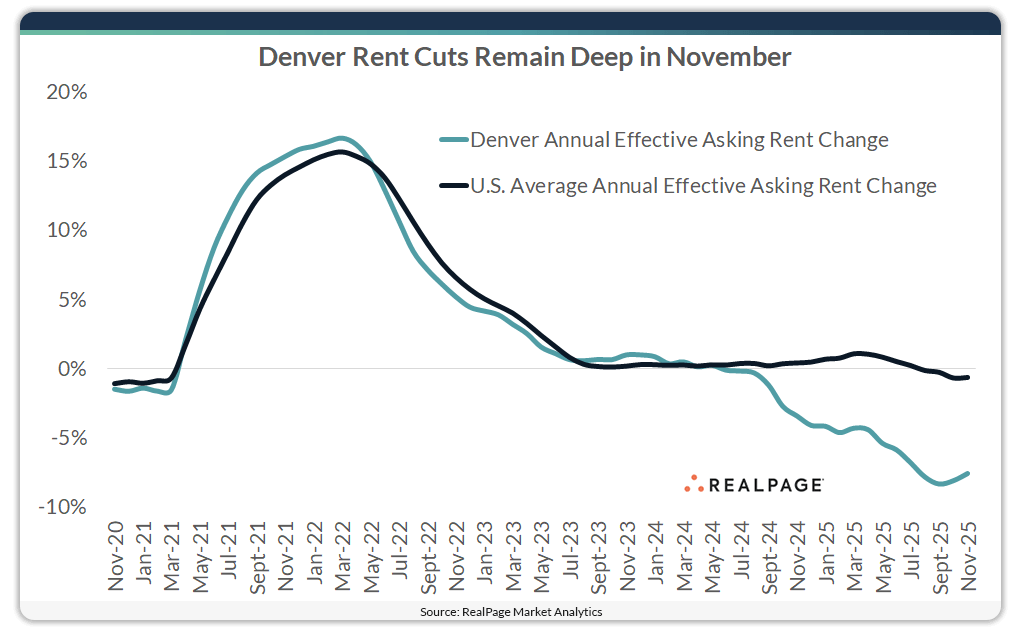
Decelerating momentum in demand and occupancy has led Denver’s operators to cut rents significantly. Rents plunged 7.6% in the year-ending November as operators tried to shore up occupancy. That was the second-deepest cut across the nation’s top 50 markets, behind only Austin (-7.9%). Three submarkets saw rent cuts surpass 10%: Southeast Denver (-10%), Glendale (-10.9%) and North Aurora (-11.2%).
Denver’s population eclipsed 3 million as of 2024, ranking as the 18th-largest market in the nation, based on the latest estimates from the U.S. Census Bureau. From 2020 to 2024, the area grew 2.8%, slightly above the U.S. average population increase of 2.6%. With a solid base of colleges and universities, Denver boasts one of the most educated and affluent populations in the U.S. The median household income in Denver notches above $97,100, about 24% above the national norm ($78,538).
Job growth in Denver slowed recently. In the year-ending August 2025, Denver employers reduced the local workforce by 3,400 jobs. Those cuts shrank the employment base 0.2%, below the U.S. average of 0.8% growth. Yet, as of August 2025, Denver boasted 107,800 more jobs than the market had in February 2020, before the COVID-19 pandemic downturn. That growth translates to a rate of 7%, above the U.S. average of 5.6%.
Still, unemployment in Denver has been comparatively low, registering at 3.7% in August, the fourth-lowest rate among the 50 largest U.S. markets. Jobs in Professional/Business Services comprise just over 19% of the Denver workforce but only 14% nationally. Trade/Transportation/Utilities also grabs a significant portion of the market share accounting for nearly 18% of jobs – Denver ranks #8 for NASA funding, as reported by the Denver Metro Chamber of Commerce.
Although job growth has slowed, strong demand drivers should allow performance in Denver to improve in the near term as completions ease. Occupancy is expected to tighten in 2026. However, rent performance will likely remain negative throughout the year with a rebound in early 2027.